Search This Website

Thursday, 2 June 2016

Jamun Fruit (Black Plum) Farming And Amazing Health Benefits

                       
                                Jamun Black Plum


The jamun is an important indigenous minor fruit of commercial value. It is also known as black plum, Indian black cherry, Ram jamun etc. in different parts of India. The tree is tall and handsome, evergreen, generally grown for shade and windbreak on roads and avenues.
Jamun are berries with an oblong shape similar to Kalamata olives. They have a dark purple to almost black skin with a starkly contrasting pink or white flesh. The flesh is extremely juicy and has a flavor that combines sweet and tart with a slightly astringent aftertaste. The fruit contains a hard seed which should be discarded. When eaten, the dark-colored skin leaves a stain on the lips and mouth that can last for several hours.


The original home of jamun is India or the East Indies. It is also found in Thailand, Philippines, Madagascar and some other countries. The jamun has successfully been introduced into many other subtropical regions including Florida, California, Algeria, Israel, etc.
Jamun fruit are native to India and surrounding countries: Nepal, Pakistan and Sri Lanka. The tree was introduced to the US via Florida in 1911. Jamun fruit does not ripen off the tree and individual berries ripen at different times; fruit is picked daily and is most often foraged. Jamun can be found a farmer’s markets in India and in the surrounding region.

In India, the maximum number of jamun trees are found scattered throughout the tropical and subtropical regions. It also occurs in the lower range of the Himalayas up to an elevation of 1,300 meters and in the Kumaon hills up to 1,600 meters. It is widely grown in the larger parts of India from the Indo-Gangetic plains in the North to Tamil Nadu in the South. The data about its total acreage in India are not available.


The jamun is propagated both by seed and vegetative methods. Due to existence of polyembryony, it comes true to parent through seed. Though vegetative methods followed in most cases have attained some success, seed propagation is still preferred. However, seed propagation is not advisable as it results in late bearing.

The seeds have no dormancy. Fresh seeds can be sown. Germination takes place in about 10 to 15 days. Seedlings are ready for transplanting for the use as rootstock in the following spring (February to March) or monsoon i.e. August to September.

Propagation of jarnun is economical and convenient. Budding is practiced on one year old seedling stocks, having 10 to 14 mm thickness. The best time for budding is July to August in low rainfall areas. In the areas where rains start easily and are heavy, budding operations are attempted early in May-June. Shield, patch and forkert methods of budding have proved very successful. The possibility of better success has been reported in forkert method compared to shield or 'T' budding.


Jamun can also be propagated by inarching but it is not adopted commercially. In this method one year old seedlings raised in pots are inarched with mother jamun trees with the help of wooden stands during June-July.

About 60% air layers are obtained with 500 ppm IBA in lanolin paste, provided air layering is done in spring and not in the rainy season.

Better rooting through cutting is obtained in Jamun under intermittent mist. Semi-hardwood cuttings of both S. jambos and S.javanica, 20-25 cm long, taken from the spring flush and planted in July treated with 2000 ppm IBA (indole butyric acid) give better results.


Planting

Jamun is an evergreen tree and can be planted both in spring i.e. February -March and the monsoon season i.e. July-August. The latter season is considered better as the trees planted in February- March have to pass through a very hot and dry period in May and June soon after planting and generally suffer from mortalities from the unfavourable weather conditions.

Prior to planting, the field is properly cleared and ploughed. Pits of 1 x 1 x 1 m size are dug at the distance of 10m both ways. Usually, work of digging of pits is completed before the onset of monsoon. The pit are filled with mixture of75% top soil and 25% well rotten farmyard manure or compost.
Another common way of growing jamun trees is to plant them as shade trees near the farm dwellings and wells. Here they provide a welcome shadow besides fruit.

In early stages, the jamun tree requires frequent irrigations but af1cr the trees gets established, the interval between irrigations can be greatly decreased. Young trees require 8 to 10 irrigations in a year. The mature trees require only about half the number, which should be applied during May and June when the fruit is ripening. During autumn and winter months, just an occasional irrigation may be applied when the soil is dry. This will also save the trees from the ill effects of frost in winter.


Flowering and Fruiting 

Flowers are borne in the axils of leaves on branchlets. In North Indian conditions, flowering starts in the first week of March and continues up to the end of April. The pollen fertility is higher in the beginning of the season. The maximum receptivity of stigma is one day after anthesis.
The jamun is a cross-pollinated and the pollination is done by honey bees, houseflies and wind. The maximum fruit set can be obtained by hand pollination when it is done after one day of anthesis. Thereafter, a sharp decline is observed in fruit set.
There is heavy drop of flowers and fruits within 3 to 4 weeks after blooming. Later natural fruit drop can be reduced with two sprays of GA3 60 ppm, one at full bloom and another 15 days after initial setting of fruits.
The pattern of growth and fruit development of jamun can be divided into three phases: the first phase from 15-52 days after fruit set having slow growth of fruit, the second phase from 52 to 58 days after fruit set having fast growth and the third and last phase from 58 to 60 days after fruit set having slow growth and very little addition in fruit weight.

Storage and Marketing

The fruits are highly perishable in nature. They cannot be stored for more than 3 to 4 days under ordinary conditions. However, pre cooled fruits packed in polythene bags can be stored well up to three weeks at low temperatures of 8 to 10°C and 85 to 90% relative humidity.
The fruit is packed and sent to the market almost daily. For marketing, well ripe and healthy fruits are selected. Damaged, diseased and unripe fruits are discarded. These selected fruits are then carefully packed in wooden baskets and sent to the local markets.

Read More »

Wednesday, 1 June 2016

The Ramoji Film City Hyderabad The largest integrated film city in the world. Famous Place of India


                                                    The Ramoji Film City


The Ramoji Film City in India is located in Hyderabad. At 2000 acres, it is the largest integrated film city in the world.
It is also a popular tourism and recreation centre, containing both natural and artificial attractions including an amusement park. The Outer Ring Road Phase 2 has acquired lands at the entrance and is set to intersect the city.

Ramoji Film City is located around 25km from Hyderabad and is accredited as one of the largest incorporated film studio complexes in the world. It was opened by the Indian Film Producer Ramoji Rao in the year 1996, as a tribute to the captivating magic of cinema and is now a dream destination for entertainment, recreation and tourism. Millions of tourists from all over the world swarm the Film City every year to get down in its never-ending leisure and recreation options. 

Spread across thousands of acres of land, Ramoji Film City consists of both artificial as well as natural attractions. These include some beautiful gardens, hills, lakes, artificial waterfalls, amusement parks, and striking architecture, making it one of Asia’s fastest growing tourism destinations. There are live performances and shows within the complex amphitheatre. 

Ramoji Film City has amazing outdoor attractions, like the Mughal Gardens, Sun Fountain, Majestic Garden, Enthraller – amphitheatre, just to name a few. The complex also has urban backdrops of the US and Australia, with Amazon Army Base being the newest additions to the place. Other highlights are the dancing Ballerina Fountain, Animal Kingdom, Hawa Mahal, the ETV planet, an airport terminal, a railway station, churches, mosques and temples, and imposing palaces resembling the real ones. Other entertainment sections especially for kids are various thrilling rides, Fundustan – a fantasy world, Dadajinn's Ark – a video games parlour, Thrillville – an adventure land, Wonderville – a toy land, Timberland – a play zone, and Borasura for a scary experience! 


If you cannot visit the leading studios of the world, you can still have a SILVER SCREEN MAGIC experience at Ramoji Film City! Ramoji Film City is literally a fantasy world created for the celluloid, with every conceivable set and location. The tour takes one full day if you hop on the coaches provided within the complex, and the tour provides the visitors an insight into the making of Cinema and the fragility of the magnificent sets, and the make belief of various aspects of cinema are very well captured and presented. 
You enter a world where a pallet of various cultures make you happy and full of life. Beautifully choreographed performances by our highly trained artists will make you tap your feet to the beats of the country’s cultural diversity. The rhythm you will take back home will last forever


And if you are a shopping buff then there is a lot for you to pick from at the outlets here, some of which include handicrafts, pottery, paintings, and jewellery.


Best time to visit

Winter is the best time to visit Ramoji Film City as Hyderabad gets very hot during summers. Ideally, one should visit Ramoji Film City from October to February, when the weather is cool and at its best.
While you walk on the Ramoji Film City land, with your loved one discussing your thrilling experience so far, imagine a band of wonderful dancers thronging the visitors suddenly and playing to the gallery in an unmatchable manner. We ensure that your mood will be out of the world.


Trivia

Ramoji Film City is certified by the Guinness World Records as the world’s largest film city.

Ramoji Film City is spread over 9000 acres, i.e. 36km of land, and it is believed that it takes almost three days to explore the entire complex!


Timing

Ramoji Film City is open on all days from 9:00 am – 5:00 pm. The ticket counter closes by 2:00 pm.


Read More »

Tuesday, 31 May 2016

The Great Rann of Kutch This is one of the Hottest areas of India Famous Place of India


                           The Great Rann of Kutch


The Great Rann of Kutch is a seasonal salt marsh located in the Thar Desert in the Kutch District of Gujarat, India and the Sindh province of Pakistan. It is about 7,505.22 square kilometres (2,897.78 sq mi) in size and is reputed to be one of the largest salt desert in the world. This area has been inhabited by the Kutchi people.
The name "Rann" comes from the Hindi word ran  meaning "desert". The Hindi word is derived from Sanskrit/Vedic wordiriṇa attested in the Rigveda and Mahābhārata. As early as 325 BCE, Alexander the Great was aware of the area.

The Great Rann of Kutch, along with the Little Rann of Kutch and the Banni grasslands on its southern edge, is situated in the district of Kutch and comprises some 30,000 square kilometres (10,000 sq mi) between the Gulf of Kutch and the mouth of the Indus River in southern Pakistan. The marsh can be accessed from the village of Kharaghoda in Surendranagar District.
In India's summer monsoon, the flat desert of salty clay and mudflats, which average 15 meters above sea level, fills with standing water. In very wet years, the wetland extends from the Gulf of Kutch on the west through to the Gulf of Cambay on the east.


The area was a vast shallow of the Arabian Sea until continuing geological uplift closed off the connection with the sea, creating a vast lake that was still navigable during the time of Alexander the Great. The Ghaggar River, which presently empties into the desert of northern Rajasthan, formerly emptied into the Rann of Kutch, but the lower reaches of the river dried up as its upstream tributaries were captured by the Indus and Ganges thousands of years ago. Traces of the delta and its distributary channels on the northern boundary of the Rann of Kutch were documented by the Geological Survey of India in 2000.


The Luni River, which originates in Rajasthan, drains into the desert in the northeast corner of the Rann. Other rivers feeding into the marsh include the Rupen from the east and the West Banas River from the northeast.

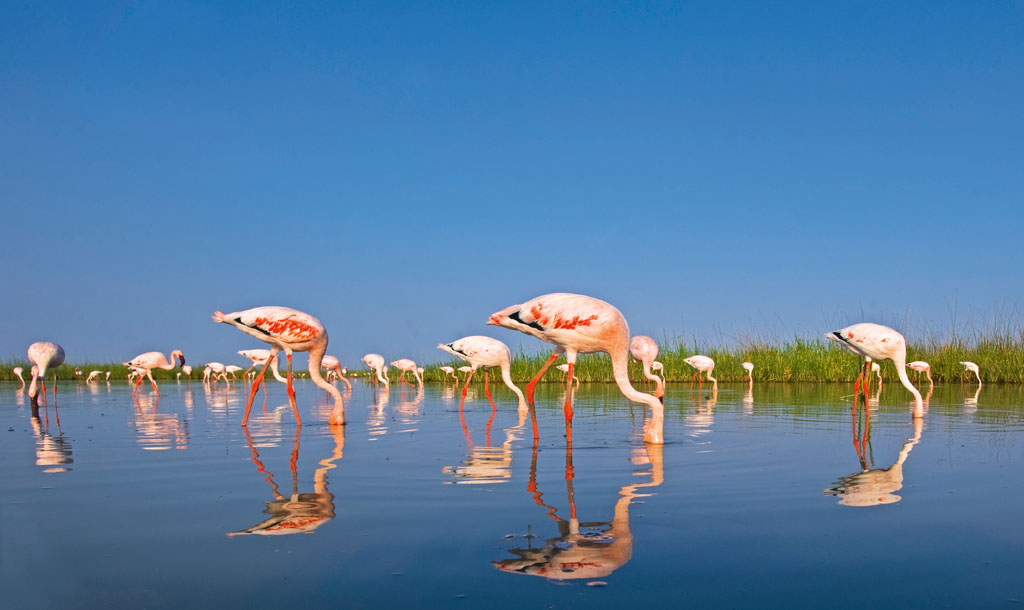
There are sandy islets of thorny scrub, forming a wildlife sanctuary and a breeding ground for some of the largest flocks of greater and lesser flamingos. Wildlife, including the Indian wild ass, shelter on islands of higher ground, called bets, during the flooding.
This is one of the hottest areas of India - with summer temperatures averaging and peaking at 49.5 °C. Winter temperatures reduce dramatically and can go below 0 °C (32 °F).

Many religions are found here, including Buddhism HinduismIslamJainism & Sikhism .


The Indus river had been flowing in to Rann of Kutch area and Rann of Kutch used to be its catchment area forming part of its delta. Indus river branch called Koree river, shifted its course after an earthquake in 1819 isolating Rann of Kutch from its delta. Pakistan has constructed Left Bank Outfall Drain (LBOD) project to bypass the saline and polluted water which is not fit for agriculture use to reach sea via Rann of Kutch area without passing through the Indus delta. The 500 km long LBOD, begins from northern Ghotki district in Sindh province of Pakistan and joins Rann of Kutch in Badin district of Sindh. Rann of Kutch is joint water body of India and Pakistan. Water released by the LBOD is enhancing the flooding in India and contaminating the quality of water bodies which are source of water to salt farms spread over vast area. The LBOD water is planned to join the sea via disputed Sir Creek but LBOD water is entering Indian territory due to many breaches in its left bank caused by floods

The Government of Gujarat hosts an annual 3 month long festival called the Rann Utsav (Festival of the Rann), where tourists can see the various sights of the Rann as well as get a taste of the local culture, cuisine and hospitality. Specially built local houses are also used to house tourists to give them a taste of them. Many adventure clubs and travel clubs organize expeditions.


Read More »

Amer Fort,Jaipur Rajasthan Famous Place of India


                                               Amer Fort, Rajasthan


Amer Fort or Amber Fort, is located in Amer, a town with an area of 4 square kilometres (1.5 sq mi) located 11 kilometres (6.8 mi) from Jaipur, Rajasthan state, India. Located high on a hill, it is the principal tourist attraction in the Jaipur area. The town of Amer was originally built by Meenas, and later it was ruled by Raja Man Singh I (December 21, 1550 – July 6, 1614).
Amer Fort is known for its artistic Hindu style elements. With its large ramparts and series of gates and cobbled paths, the fort overlooks Maota Lake. It is the main source of water for the.


The aesthetic ambiance of the palace is seen within its walls. Constructed of red sandstone and marble, the attractive, opulent palace is laid out on four levels, each with a courtyard. It consists of the Diwan-e-Aam, or "Hall of Public Audience", the Diwan-e-Khas, or "Hall of Private Audience", the Sheesh Mahal (mirror palace), or Jai Mandir, and the Sukh Niwas where a cool climate is artificially created by winds that blow over a water cascade within the palace. Hence, the Amer Fort is also popularly known as the Amer Palace. The palace was the residence of the Rajput Maharajas and their families. At the entrance to the palace near the fort's Ganesh Gate, there is a temple dedicated to Sila Devi, a goddess of the Chaitanya cult, which was given to Raja Man Singh when he defeated the Raja of Jessore, Bengal in 1604. (Jessore is now in Bangladesh).
This palace, along with Jaigarh Fort, is located immediately above on the Cheel ka Teela (Hill of Eagles) of the same Aravalli range of hills. The palace and Jaigarh Fort are considered one complex, as the two are connected by a subterranean passage. This passage was meant as an escape route in times of war to enable the royal family members and others in the Amer Fort to shift to the more redoubtable Jaigarh Fort
Annual tourist visitation to the Amer Palace was reported by the Superintendent of the Department of Archaeology and Museums as 5000 visitors a day, with 1.4 million visitors during 2007


At the 37th session of the World Heritage Committee held in Phnom PenhCambodia, in 2013, Amer Fort, along with five other forts of Rajasthan, was declared a UNESCO World Heritage Site as part of the group Hill Forts of Rajasthan.

According to Tod this region was known as Khogong. The Meena King Raja Ralun Singh also known as Alan Singh Chanda of Khogong kind-heartedly adopted a stranded Rajput mother and her child who sought refuge in his realm. Later, the Meena king sent the child, Dhola Rae, to Delhi to represent the Meena kingdom. The Rajput, in gratitude for these favours, returned with Rajput conspirers and massacred the weaponless Meenas on Diwali while performings rituals i.e. Pitra Trapan, it is customery in the Meenas to be weaponless at the time of PitraTrapan, "filling the reservoirs in which the Meenas bathed with their dead bodies" [Tod.II.281] and thus conquered Khogong.This act of Kachwaha Rajputs was termed as most coward and shameful in history of Rajasthan.
The first Rajput structure was started by Raja Kakil Dev when Amber became his capital in 1036 on the site of present day Jaigarh Fort of Rajasthan. Much of Amber's current buildings were started or expanded during the reign of Raja Man Singh I in the 1600s. Among the chief building is the Diwan-i-Khas in Amber Palace of Rajasthan and the elaborately paited Ganesh Poll built by the Mirza Raja Jai Singh


The Palace is divided into four main sections each with its own entry gate and courtyard. Main entry is through the Suraj Pole (Sun Gate) which leads to Jaleb Chowk, the first main courtyard. This was the place where armies would hold victory parades with their war bounty on their return from battles, which were also witnessed by the Royal family's women folk through the latticed windows. This gate was built exclusively and was provided with guards as it was the main entry into the palace. It faced east towards the rising sun, hence the name "Sun Gate". Royal cavalcades and dignitaries entered the palace through this gate.


Jaleb Chowk is an Arabic phrase meaning a place for soldiers to assemble. This is one of the four courtyards of Amer Palace, which was built during Sawai Jai Singh’s reign (1693–1743 AD). The Maharaja's personal bodyguards held parades here under the command of the army commander or Fauj Bakshi. The Maharaja used to inspect the guards contingent. Adjacent to the courtyard were the horse stables, with the upper level rooms occupied by the guards.


Read More »

Sunday, 29 May 2016

The Hingland, Coorg Scotland of India Famous Place of India


The Highland, Coorg


Disheveled meadow swells aloft
And the sailing blue whispers the song
Tickles the niched nature wind soft
Unearthed ecstasy stays strong

Coorg in Karnataka in South India is a beautiful hill resort. 252 kms from Bangalore and 1525 m above sea level lies Coorg, the district headquarters of Kodagu. Coorg or Kodagu(originally called Kodaimalenadu) means 'dense forest on steep hill'. It is beautiful hill country most of which is between 3000 and 4000 feet high. The tallest mountain peak is around 6000 feet high. Also known as Kodagu, Coorg is famous for coffee plantations. The coffee estates here produce some of the world's best coffee.

Kodagu has three taluks - Madikeri, Virajpet and Somwarpet. Steep hills, valleys and gorges with countless streams that gurgle through them, beckon intrepid trekkers and rock climbers. Misty hills, lush forest, acres and acres of tea and coffee plantation, orange groves, undulating streets and breathtaking views are make Coorg an unforgettable holiday destination


Nagarhole National Park : The place derives its name from the winding river - Nagarhole meaning "snake river" - which flows through the park. With over 250 varieties of birds, panthers, tigers, and flying squirrels, this park is made up of teak, rosewood, sandalwood, silver oak etc. Jeeps and elephants are available to tourists for transport. You can reach the park from Mysore via Hunsur and Murkal.
Talacauvery : This forms the source of the river Kaveri. A perennial spring situated at a height of 4,500 ft is the beginning of this mighty river. It is 45 km from Madikeri and also offers a spectacular view.
Abbi Falls : This water fall was also known as Jessey Falls.'Abbi' in the local language Kodagu means falls. Situated 8 Km from Madikeri, the beautiful Abbey Falls are a popular tourist attraction in the hill resort of Coorg. Even during the summer there is plenty of water in these falls. The roar of the falls can be heard from the main road, from where a path goes through lovely coffee and cardamom plantations right up to them.

Iruppu Falls : These scenic waterfalls are situated at a distance of 48 kms from Virajpet on the way to Nagarhole. River Lakshmana-tirtha flows nearby. The people of Coorg believe that bathing in the Iruppu Falls will wash ones sins away. On the Holy day of Shivarati, devotees come in large numbers to bathe in these falls.
The Omkareshwar temple : This temple is dedicated to Lord Shiva, it has a mix of Islamic and Gothic style architecture. On the top of the dome of the temple is a guilded ball, with a weather clock. It is unique for its architectural beauty which is a combination of Islamic and Gothic style of architecture.


The Raja's Seat : This is a beautiful viewpoint in Coorg. This hilltop offers stunning views of the surrounding forests and the view of the sunset. It is said that the kings of Kodagu came to this viewpoint to see the panoramic view of their kingdom and spent their evenings.
Bhagamandala : It is situated at the confluence of 3 rivers (the Cauvery, the Kanika and the Sujyothi). It is famous for temples and is known as the temple town of this region. The temple here, built in Kerala style, has smaller shrines dedicated to various gods.
Madikeri Fort : Situated in the middle of Madikeri, this historic fort which was built in the 19th century, contains a museum, a prison, a chapel and a temple.


Sight Seeing And Trekking At Madikeri

Madikeri has an array of sightseeing spots for you to enjoy and a variety of activities too. There is the Madikeri fort which was built in the 19th century and consists of a palace, chapel and prison. The fort overlooks the town, and the view is almost breathtaking in the night.
It is believed that all the Kings in the Kodagu vicinity would come and spend their free time at Raja’s Seat. There are a herd of tourists that come to watch the sunset in the evening.

Abbey falls is about 8 km from Madikeri. It is the perfect place to spend an entire day, have a picnic, and laze around. Bhagamandala is a temple that is built at the junction of the Cauvery, Kanika, and Sujyothi rivers. It has a number of shrines all built under one roof.
Talacauvery is a very auspicious spot as it is the site of the origin of the riverCauvery. Nisargadhama is a very serine picnic spot, where you can enjoy the view with some delicious delicacies. Trekking is one of the major activities at Madikeri, and some of the trekking spots are Thadiyandamole, Pushpagiri, Brahmagiri, and Nishanimotte and many more.

How To Reach Madikeri

You can get to Madikeri either by air as the closest airport is at Mangalore, which is only an hour’s drive away, or you can take a train till Thalassery, Kasaragod, or Mysore and then drive down to Madikeri. Bus and taxi services from Bangalore, Mysore, or Calicut to Madikeri are available in plenty.

Local Food and Accommodation


Madikeri has some sumptuous traditional dishes on offer for you. You must look out for the Pandhi, Koli and Bembla curry, Kadumbuttu, and the Votti. There is also the traditional south Indian food like dosa, idly, vada, and sambar. For lunch, their main delicacy is rasam served with some hot rice and an array of cooked vegetables.


There are a number of hotels and resorts ranging from the luxury five stars to the mediocre ones. You can find a nice comfortable place to stay to make your trip even more memorable.


Madikeri is a very popular hill station with the tourists, and it is just the place if you want to get away from your everyday routine.
Read More »