Search This Website

Showing posts with label FAIRS AND FESTIVALS. Show all posts

Sunday, 2 October 2016

Real Meaning of Happiness Navratri, Festival of Navratri is full of lights, joy and festivity


                        Navratri


                     Image result for cute girls navratri celebration


Festival of Navratri is full of lights, joy and festivity. Hindus celebrate this with devotion and enthusiasm throughout India. The celebration is carried on for ten days and the last four days are very important. Navratri means nine nights and so the tenth day Goddess Durga, who is worshipped throughout the nine days, is immersed in holy water after pooja. Each and everyday has its importance and meaning. People worship Goddess in three forms and try to enhance their physical, mental and spiritual practice in these nine days. 

Navaratri is a festival dedicated to the worship of the Hindu deity Durga. The word Navaratri means 'nine nights' in Sanskrit, nava meaning nine and ratri meaning nights. During these nine nights and ten days, nine forms of Devi are worshipped. The tenth day is commonly referred to as Vijayadashami or "Dussehra" (also spelled Dasera). Navaratri is an important major festival and is celebrated all over India and Nepal. Diwali the festival of lights is celebrated twenty days after Dasera. Though there are in total five types of Navaratri that come in a year, Sharad Navaratri is the most popular one. Hence, the term Navaratri is being used for Sharada Navaratri here.

Navratri festival is celebrated twice a year, though the one that is celebrated in September or October is well-known and celebrated with extreme passion and fervour. Some Hindus believe that every night one form of Goddess is worshipped while some believe that three forms of Goddess are worshipped and they are the trinity of God. The celebration varies from one state to another although the dedication and devotion remains the same all over India.


                   Image result for cute girls navratri celebration

Navratri Celebration and Fasting

Some people eat only fruits and drink milk during the entire nine days and nights. 

Some eat meal one time a day and that meal should be satvik, which means vegetarian meal which is prepared without the use of onion and garlic. 

Fasting is not compulsory and even after few years if the devotee feels that he or she is not capable of continuing fast during Navratri, he or she can discontinue also. 

It is good to keep mind, body and thoughts pure during the time of Navratri. 

If possible try to light a Jyot in front of Goddess Durga's statue or at least a picture throughout the nine days and nights. 

Start the prayers with praying for Lord Ganesha and then perform aarti in front of Goddess Durga. 

Men do not shave or cut their hair during this period. 

People do not wear black clothes during this period and avoid keeping leather goods with them. 

People worship young girls and feed them with sweets and different types of traditional and delicious food items. They consider them as form of Goddess Durga. 

Since it is believed that Goddess is fond of red flowers and red colour, women and young girls prefer wearing clothes in red and yellow colour.


                   Image result for navratri celebration in city


Fasting commences on the ninth night of Navratri.

People pray to Goddess Durga to destroy the evil during Navratri. They ask help and strength from the Goddess to fight against the evil and protect the Hindu dharma. In West Bengal, men and women celebrate Navratri festival as Durga Pooja and worship huge idols of Goddess Durga. In Gujarat people perform traditional dance which is known as Garba almost throughout the night. They wear colourful dresses and mostly Indian traditional dresses are preferred. 

Chaitra Navratri is celebrated after Holi and during Chaitra Shukla Paksha. This starts from the first day and ends on the ninth day which is also celebrated as Ram Navmi. The worship of Goddess on the eighth day is very important and auspicious and is significant in both Navratri festivals. 

Dussehra or Navratri is also celebrated as Lord Rama's victory over the Demon king Ravana. He was the ten headed king of Lanka and had kidnapped Rama's wife, Sita. The main objective is, however, to celebrate the victory of good over the evil. 

Nine forms of Shakti are worshipped during the Navaratris. The Devis worshipped depend on the tradition of the region.

In Western India, particularly in the state of Gujarat and Mumbai, Navaratri is celebrated with the famous Garba and Dandiya Raas dance. Since the past few years, the Government of Gujarat has been organising the "Navaratri Festival Celebrations" on a regular basis for the nine days of Navaratri Festival in Gujarat. People from all over Gujarat and even abroad come to participate in the nine-day celebration. It is also popular throughout India and among Indian communities around the world including the UK, Canada, Malaysia, Singapore and USA.


                  Image result for girls navratri festival

Durga
Kali
Amba or Jagadamba, Mother of the universe
Annapoorna devi or Gauri, The one who bestows grains (anna) in plenty (purna: used as subjective)
Sarvamangala or Sheetal, The one who gives happiness (mangal) to all (sarva)
Bhairavi
Chandika or Chandi
Lalita
Bhavani
Mookambika or Tara


Read More »

Friday, 16 September 2016

Sair – One Festival, Many Stories. It's a fair celebrated in Himachal Pradesh to mark the end of the crop harvest, prepare for the harsh winter ahead and the return of the gods from heaven.

                     
                     Sair Festival

                    Image result for sair festival himachal pradesh

The state of Himachal Pradesh is blessed in more ways than one. Its stunning landscape is a sight for sore eyes; whereas, the warm, hospitable people make a trip to Himachal Pradesh very special. Often referred to as the Abode of Clouds, it’s no secret that Himachal Pradesh is the perfect setting for numerous fairs and festivals. The locals are as enterprising as they are hospitable and this makes any festival organized in this region very special. In the long list of festivals and fairs organized in Himachal Pradesh, one is the Sair Festival, which is organized in Shimla.


                   Image result for sair festival himachal pradesh


During the festival, the hosting region comes alive with all sorts of lights and sounds and the sensory experience is paramount. The highlight of the fair is a unique buffalo fight. The Sair Festival boasts of a fantastic location and provides a unique foray into the lives of locals and their rich heritage. It provides a wonderful opportunity to soak in the enriching ambience as well as enjoy a unique macroscopic view of the Indian traditions and culture at the same place. Locals gather together and make all the arrangements for the festival which is organised at a grand scale and tourists from all over the country as well as numerous parts of the world gather every year to celebrate this festival.
Month of Celebration of The Festival

                          Image result for sair festival himachal pradesh

The Sair Festival is one of the many festivals organised as part of Himachal Pradesh’s rich cultural heritage. This festival is usually organised in the month of September and it is celebrated every year in Himachal Pradesh with much fanfare. The festival provides the perfect escape from the humdrum of daily life and locals find relief from the monotonous existence and partake in the festivities to celebrate life, colour and happiness. To celebrate the abundant natural beauty and the rich cultural heritage of Himachal Pradesh, the locals get together, form committees, organise this festival every year. Visitors, too, visit the region to partake in the festivities.
"Though the fair has lost its traditional charm and saw the invasion of modernism, still the locals celebrate it with enthusiasm by participating in bullfights and offering harvest crop to the god," Shiv Singh, a local in Mashobra, told IANS.
He said as per the tradition the elders in a family offered "dhruv", a sacred grass, with dry fruits items by the younger family members.
The festival also sees purchase of utensils and clothes and cooking of special dishes.
"More than 50 bulls, reared by the locals especially for the occasion, would participate in the bullfights," he said.
Before the fights, the bulls are generally drugged or made to drink alcohol to keep them charged up.
During the months of September, this astonishing festival is celebrated in Shimla and in Arki in Solan, right in lap of nature. The beautiful and exotic state of Himachal Pradesh is the best place to organize such festivals. A grand fair is part of the festivities during this time where visitors from various parts of the country gather together and indulge in various activities. Men and women, old and young, students and professionals, all sorts of people visit Shimla for the wondrous Sair Festival.
Description About Sair Festival
Keeping up with the tradition of all things grand, the Sair Festival in Himachal Pradesh is also celebrated on a huge scale. Thousands, even lakhs of people, visit the fair and enjoy the numerous offerings. People enjoy an extended vacation with their family, friends and other loved ones. They also relish the quiet hillside environment. Rejuvenating and refreshing, a trip to the Sair Festival is a lot more than just a visit to Shimla. It’s a whole experience in itself. The festival is celebrated on a grand scale. Various activities are part of the fair that is organized to celebrate this festival. Street plays, dances, songs, acrobatics, and games are all part of the festival and the fair. Stalls are set up and locals sell a variety of items especially designed keeping in mind the tourist populace that visits the valley for the Pori Festival.

                     Image result for sair festival himachal pradesh

While the festival is organized mostly in Shimla, at a close distance, in Arki in Solan, a special event is organised. On the lines of the bull fights of Athens, a special buffalo fight is organised. The difference between the events in Athens and that in India is that in India even the general public can be the audience after paying a small sun – a practice that is not employed in Athens where this event is only accessible to a select few. Arki in Solan where this event is organised, has abundant greenery and numerous kinds of flowering plants and the sheer beauty of the region is a real sight to behold.
The festival of Sair boasts of not just a fantastic location but also a foray into the lives of locals, especially the artists. Local craftsmen set up stalls to attract the tourists visiting the region and this works well for both the tourists who are on the lookout for traditional handicrafts and for the artists who are always in need of more opportunities. The festival enables a rich give and take, thus, of not just goods of all kinds, but also of ideas. The human spirit of generosity is visible during the various events at the Sair Festival.
Sair – One Festival, Many Stories
Read More »

Monday, 5 September 2016

In India, Ganesha Chaturthi is primarily celebrated at home and in public by local community groups in the western states of Maharashtra,Gujarat and Goa and the southern states of Karnataka,Kerala, Andhra Pradesh, Telangana, and Tamil Nadu


                 Ganesha Chaturthi

                         Image result for about ganesh utsav


Ganesha Chaturthi  is the Hindu festival celebrated in honour of the elephant-headed god, Ganesha. This is a very auspicious day celebrated to pray to the god so that every new activity that is started is successfully completed without any obstacles (Vighna = Obstacle).
In India, Ganesha Chaturthi is primarily celebrated at home and in public by local community groups in the western states of Maharashtra,Gujarat and Goa and the southern states of Karnataka,Kerala, Andhra Pradesh, Telangana, and Tamil Nadu
Lord Vinayaka, Ganesh ji, Ganpati ji, Vinayaka is the darling of the masses. Ganesh Chaturthi brings people of all religion, caste and creed together.
Ganesh Chaturthi is celebrated with great devotion all over India. People bring home murtis (Idols) of Lord Ganesha and celebrate the festival by worshiping the Lord in a special way for a day and a half, 3 days, 5 days, 7 days or 11 days depending on the family tradition and commitment of each individual.
On the last day of worship the idol is taken out in a colourful and musical procession to be immersed traditionally at a beach.

                                    Image result for ganesh mahotsav

Chaturthi (Hindi चतुर्थी) means "fourth day" or "fourth state". Celebrations are traditionally held on the fourth day of the second fortnight (Shukla Chaturthi) in the month of Bhaadrapada in the Hindu calendar, usually August or September in the Gregorian calendar. Badrapad corresponds to Virgo (simha/avani-tamil) in solar calendar. The festival generally lasts ten days, ending on the fourteenth day of the fortnight (Anant Chaturdashi).
The festival is celebrated by families at home, by people at their places of work and in public. The public celebration involves installing clay images of Ganesha in public pandals (temporary shrines) and group worship. At home, an appropriately-sized clay image is installed and worshipped with family and friends. At the end of the festival, the idols are immersed in a large body of water such as the sea, river or a lake. The clay idols disintegrate over time in the water.

                     Image result for ganesh mahotsav

It is celebrated throughout India, especially in Maharashtra, Andhra Pradesh and Telangana. There is a grand celebration in the state of Maharashtra by traditional instrument called dhol and tasha. It is also celebrated in the other parts of India such as Gujarat,Karnataka, Tamil Nadu, Kerala,Goa, Odisha, Madhya Pradesh, Chhattisgarh and other parts of western and southern India.Abroad, Ganesha Chaturthi is observed in the Terai region of Nepal and by the Hindu diaspora in the United States, Canada and Mauritius.

Public Preparations for the festival begins months ahead. These pandals are usually funded by local residents and are collected through fairs and workshops.The idol making in Maharashtra usually begins with"Padya pooja" or worshipping the feet of lord ganesh. The idols are brought to "pandals" or temporary structures usually 15–20 days before. At home the festival begins with the selection and installation of a clay murti (idol). Families decorate a small, clean corner with flowers and other colourful items before installing the idol. When the idol is installed, it and its shrine are decorated with flowers and other materials.

                     Image result for Girls in  ganesh utsav

In preparation for the festival, artisans create clay models of Ganesha for sale. The idols range in size from 3⁄4 inch (1.9 cm) for homes to over 70 ft (21 m) for large community celebrations. The date for the festival is usually decided by the presence of chaturthi thithi. The festival is held during"Bhadrapada madyahanaa purvabaddha". If chaturthi thiti begins at night on previous day and gets over by morning on next day then the next day us observed as vinayaka chaturthi. In the consecration ceremony, a priest performs a Prana Pratishtha to invite Ganesha into the idol. This is followed by the 16-step Shodashopachara ritual, (Sanskrit: Shodash, 16; Upachara, process) during which coconut, jaggery, modaks, durva grass and red hibiscus flowers are offered to the idol. Throughout the ceremony, hymns from the Rigveda, the Ganapati Atharvashirsa, the Upanishads, and the Ganesha stotra (prayer) from the Narada Purana are chanted. Aartis are performed with friends and family, typically in the morning and evening

                      Image result for ganesh mahotsav in girls college

At homes in Maharashtra, families install small clay statues for worship during the festival. The idol is worshiped in the morning and evening with offerings of flowers, durva (strands of young grass), karanji and modaks. The worship ends with the singing of an aarti in honour of Ganesha, other gods and saints. In Maharashtra the Marathi aarti "Sukhakarta Dukhaharta", composed by Samarth Ramdas in the 17th century, is sung. Family traditions differ about when to end the celebration. Domestic celebrations end after 1, 1 1⁄2, 3, 5, 7 or 11 days, when the idol is brought to a body of water (such as a lake, river or the sea) for immersion. Due to environmental concerns, a number of families now avoid bodies of water and let the clay statue disintegrate in a barrel of water at home. After a few days, the clay is spread in the home garden. In some cities a public, eco-friendly process is used for the immersion. In Maharashtra, Ganeshotsav also incorporates other festivals, namely Hartalika and the Gauri festival, the former is observed with a fast by women on the day before Ganesh Chaturthi whilst the latter by the installation of idols of Gauris.

                   Image result for Girls in  ganesh utsav

In Goa, Ganesh Chaturthi is known as Chavath in Konkani and Parab or Parva ("auspicious celebration"); it begins on the third day of the lunar month of Bhadrapada. On this day Parvati and Shiva are worshiped by women, who fast. Instruments such as ghumots, cymbals and pakhavajs are played during the ceremonies. The harvest festival, Navyachi Pancham, is celebrated the next day; freshly-harvested paddy is brought home from the fields (or temples) and a puja is conducted. Communities who ordinarily eat seafood refrain from doing so during the festival


Read More »

Thursday, 1 September 2016

Onam : The 'vasudhaiva kutumbakam Onam is an ancient festival which still survives in modern times Festivals of India


                     Onam Festival

                       Image result for onam festival

Onam is the biggest and the most important festival of the state of Kerala. It is a harvest festival and is celebrated with joy and enthusiasm all over the state by people of all communities. According to a popular legend, the festival is celebrated to welcome King Mahabali, whose spirit is said to visit Kerala at the time of Onam.
It is also the state festival of Kerala with State holidays on 4 days starting from Onam Eve (Uthradom) to the 3rd Onam Day.

                       Image result for onam festival

Meaning of Onam

The word Onam is believed to have been originated from the Sanskrit word Shravanam which in Sanskrit refers to one of the 27 Nakshatars or constellations. Thiru in South India is used for anything associated with the Lord Vishnu and Thiruvonam is believed to be the Nakshatra of Lord Vishnu who pressed the great King Mahabali to the underworld with his foot.
The festival falls during the Malayalam month of Chingam (Aug - Sep) and marks the commemoration of Vamana avatara of Vishnu and the subsequent homecoming of the mythical King Mahabali.[ In Kerala, it is the festival celebrated with most number of cultural elements such as Vallam Kali, Pulikali, Pookkalam, Onathappan, Thumbi Thullal, Onavillu, Kazhchakkula, Onapottan, Atthachamayam etc. Onam is reminiscent of Kerala's agrarian past, as it is considered to be a harvest festival. The official date is set by the Indian National Calendar

                    Image result for onam festival

Onam is an ancient festival which still survives in modern times. Kerala's rice harvest festival and the Festival of Rain Flowers, which fall on the month of Chingam, celebrates the Asura King Mahabali's annual visit from Patala Loka . Onam is unique since Mahabali has been revered by the Hindu people of Kerala.The King is so much attached to his kingdom that it is believed that he comes annually from the nether world to see his people living happily. It is in honour of King Mahabali that Onam is celebrated. The deity Vamana, also called Thrikkakarappan is also revered during this time by installing a clay figure next to the floral carpet (Pookalam) .The birthday of Sri Padmanabhan, the presiding Deity of Thiruvananthapuram, is on the Thiruvonam day in the month of Chingam. Thiruonam day is the most important day of Onam. In Onam 2016, Thiruvonam date is 14 September.
Mahabali's rule is considered the golden era of Kerala, ancient Bharata. The following song is often sung over Onam:
Carnival of Onam lasts from four to ten days. First day, Atham and tenth day,Thiruonam are most important of all. Popularity and presentation of rich culture of the state during the carnival made Onam the National Festival of Kerala in 1961. Elaborate feasts, folk songs, elegant dances, energetic games, elephants, boats and flowers all are a part of the dynamic festival called Onam. 

Government of India has taken due notice of this vibrant and colorful festival. It promotes Onam internationally in a big way and celebrates 'Tourist Week' for Kerala during Onam celebrations. Thousands of domestic and foreign tourists visit Kerala to be a part of Onam. 

                    Image result for onam festival


The Legend

Story goes that during the reign of mighty asura (demon) king, Mahabali, Kerala witnessed its golden era. Every body in the state was happy and prosperous and king was highly regarded by his subjects. Apart from all his virtues, Mahabali had one shortcoming. He was egoistic. This weakness in Mahabali's character was utilized by Gods to bring an end to his reign as they felt challenged by Mahabali's growing popularity. However, for all the good deed done by Mahabali, God granted him a boon that he could annually visit his people with whom he was so attached.

It is this visit of Mahabali that is celebrated as Onam every year. People make all efforts to celebrate the festival in a grand way and impress upon their dear King that they are happy and wish him well.

                    Image result for onam festival


Onam Celebrations

Rich cultural heritage of Kerala comes out in its best form and spirit during the ten day long festival. It is indeed a treat to be a part of the grand carnival. People of Kerala make elaborate preparations to celebrate it in the best possible manner. 

The most impressive part of Onam celebration is the grand feast called Onasadya, prepared on Thiruonam. It is a nine course meal consisting of 11 to 13 essential dishes. Onasadya is served on banana leaves and people sit on a mat laid on the floor to have the meal.

Another enchanting feature of Onam is Vallamkali, the Snake Boat Race, held on the river Pampa. It is a colourful sight to watch the decorated boat oared by hundreds of boatmen amidst chanting of songs and cheering by spectators.

There is also a tradition to play games, collectively called Onakalikal, on Onam. Men go in for rigorous sports like Talappanthukali (played with ball), Ambeyyal (Archery), Kutukutu and combats called Kayyankali and Attakalam. Women indulge in cultural activities. They make intricately designed flower mats called, Pookalam in the front courtyard of house to welcome King Mahabali. Kaikotti kali and Thumbi Thullal are two graceful dances performed by women on Onam. Folk performances like Kummatti kali and Pulikali add to the zest of celebrations.

                         Image result for about onam

Ten Days of Onam

The festival of Onam lasts for ten long days and each day has a unique name, significance and different activities attached to it:

Day 1 (Atham): This is the first day of Onam when Mahabali supposedly starts his preparation to head towards earth. It is marked by the beginning of designing Pookalam (only with Yellow flowers), the size of which eventually grows with each day. The statues of Vamana and King Mahabali are also installed in houses.

Day 2 (Chithira): The second day adds another layer of flowers to Pookalam and cleaning of houses starts on Chithira.

Day 3 (Chodi): Along with the addition of flowers to Pookalam, People start their shopping at this day.

Day 4 (Vishakam): This day marks the beginning of several competitions that are held during Onam.

Day 5 (Anizham): This is the day when Vallamkali Boat Race starts in many parts of Kerala.

Day 6 (Thriketa): By this time most of schools get closed and people start devoting all their time to the celebrations.

                     Image result for about onam

Day 7 (Moolam): This is the seventh day in the Onam celebrations. At several places Ona Sadya and the dances related to the festival starts being performed. The state has been decorated beautifully by this time.

Day 8 (Pooradam): This is a day when the statues of Vamana and King Mahabli are washed and installed in the middle of the Pookalam which is very big in size now.

Day 9 (Uthradom): The ninth day or the eve of Onam is of a great significance. People buy fresh vegetables and women cook the traditional meals which are very grand. King Mahabali, it is believed reaches the state of Kerala this day.

Day 10 (Thiruonam): This is the final day when all the preparations are culminated into final celebrations. People take bath early in the morning, distribute gifts and special prayers are held in temples. The grand Thiruona Sadya (Onam Special Meal) is prepared in all the households. Several competitions are held in the different parts of Kerala.
Read More »

Monday, 22 August 2016

How to celebrate Janmashtami ? Krishna Janmashtami , also known as Krishnashtami, Saatam Aatham, Gokulashtami,Ashtami Rohini, Srikrishna Jayanti, Sree Jayanti or sometimes simply as Janmashtami, is an annual celebration of the birth of the Hindu deity Krishna


                                          Janmashtami


Janmashtami commemorates the earthly appearance of Krishna, who is described in India’s sacred writings as God Himself. One of the biggest religious festivals in the world, it is celebrated by nine hundred and thirty million people around the world--and two million in the US alone. To devotees, it’s Christmas and New Year’s in one, a day of deep spiritual renewal and celebration that effectively finishes an old year and begins a fresh one.

Krishna Janmashtami , also known as Krishnashtami, Saatam Aatham, Gokulashtami,Ashtami Rohini, Srikrishna Jayanti, Sree Jayanti or sometimes simply as Janmashtami, is an annual celebration of the birth of the Hindu deity Krishna, the eighth avatar of Vishnu.

But why Janmashtami, you may ask? What’s so special about Krishna, as opposed to any other form of God? It’s His personable-ness. He reciprocates in unique, personal ways with every devotee who offers Him love—He is the most adorable, mischievous son, the most romantic lover, the most compassionate friend. And on Janmashtami, devotees celebrate Krishna in all of these aspects. For just as Krishna reciprocates individually with His relatives and confidantes, he responds to the distinct feelings and desires held most deeply in the heart of every single worshipper.
                        
So remember that whatever way you worship Krishna on Janmashtami, He will reciprocate with you accordingly. It’s a meditation that makes for an extremely rewarding devotional experience.
Krishna was the eighth son of Devaki and Vasudeva. Based on scriptural details and astrological calculations, the date of Krishna's birth, known as Janmashtami, is 18 July 3228 BCE and he lived until 18 February 3102 BCE. Krishna belonged to the Vrishniclan of Yadavas from Mathura, and was the eighth son born to the princess Devaki and her husband Vasudeva.
Mathura (in present-day Mathura district, Uttar Pradesh) was the capital of the Yadavas, to which Krishna's parents Vasudeva and Devaki belonged. King Kansa, Devaki's brother, had ascended the throne by imprisoning his father, King Ugrasena. Afraid of aprophecy that predicted his death at the hands of Devaki's eighth son, Kansa had the couple locked in a prison cell. After Kansa killed the first six children, and Devaki's apparent miscarriage of the seventh (which was actually a secret transfer of the infant to Rohini as Balarama), Krishna was born.
Following the birth, Vishnu ordered Vasudeva to take Krishna to Gokul to Nanda and Yashoda, where he could live safely, away from his Uncle Kansa. Vasudeva took Krishna with him and crossed the Yamuna to reach Gokul. There, everyone was asleep; so he quietly kept him there and returned with Yashoda's daughter. Kansa, thinking her to be Devki's eight child, threw her on a stone. But she rose into the air and transformed into Yogmaya (who is Vishnu's helper) and warned Kansa about his death. Then, she disappeared. Krishna grew up in Gokul with his brother, Balram. He then returned to Mathura and killed Kansa with the help of Balram.


How is Janmashtami Celebrated?

Where Vaishnava temples exist, festivities begin before dawn and extend all day until midnight, the exact moment of the anniversary of Krishna’s appearance. Events include kirtan, singing the Lord’s name along with other devotees; and japa, private, more intimate prayer. Some devotees cook a feast of over one hundred dishes, while others perform drama and dance. Some clothe and decorate the deity of Krishna while others string enormous flower garlands and other decorations for the temple. Incense burns, scriptures are read, and all but the young and the infirm fast all day. The deities are also bathed with a variety of auspicious liquids in a kind of ablution ceremony calledabhisheka. Sometimes taking over two hours, this is performed with great pomp.
Finally, at midnight, priests pull apart the curtains to reveal the
freshly dressed deity of Krishna on a creatively festooned and colored
altar. The excitement builds, and a rousing kirtan ensues.


How to Celebrate Janmashtami at Home

But what if you don’t live near a temple? What if you can’t make it to a major celebration Does that mean you can’t observe Janmashtami? Of course not. It is our sincere devotion that pleases Krishna most, and this can be offered anywhere. So to help you feel more connected to the Lord and His devotees on this special day, here are Krishna.com’s tips on how to celebrate Janmashtami at home:


As you celebrate Janmashtami, remember that just as we enjoy the attention and fun on our birthday, so the Lord also enjoys our attention and gifts on His appearance day. The difference between us and Krishna is that He is able to reciprocate perfectly with each one of us. In the transcendental realm, everything that we offer to the Lord with love and devotion will benefit us unlimitedly, and those benefits will stay with us for eternity.
Read More »

Thursday, 11 August 2016

We all know that Freedom is not free. It took years of efforts, non-violence and other movement by our national freedom fighter to attain Freedom.


                  Independence Day


Independence Day, is observed annually on 15 August is a national holiday in India commemorating the nation's independence from the British Empire on 15 August 1947. India attained independence following an Independence Movement noted for largely nonviolent resistance and civil disobedience led by the Indian National Congress (INC). Independence coincided with the partition of India, in which the British Indian Empire was divided along religious lines into the Dominions of India and Pakistan; the partition was accompanied by violent riots and mass casualties, and the displacement of nearly 15 million people due to sectarian violence. On 15 August 1947, Jawaharlal Nehru, who had become the first Prime Minister of India that day, raised the Indian national flag above the Lahori Gate of the Red Fort in Delhi. On each subsequent Independence Day, the prime minister has raised the flag and given a speech.


We all know that Freedom is not free. It took years of efforts, non-violence and other movement by our national freedom fighter to attain Freedom.

The holiday is observed throughout India with flag-hoisting ceremonies, parades and cultural events.there is a national holiday and schools and government offices distribute sweets but no official work is done.


European traders had established outposts on the Indian subcontinent by the 17th century. Through overwhelming military strength, the British East India company subdued local kingdoms and established themselves as the dominant force by the 18th century. Following the Rebellion of 1857, the Government of India Act 1858 led the British Crown to assume direct control of India. In the decades following, civic society gradually emerged across India, most notably the Indian National Congress Party, formed in 1885. The period after World War I was marked by British reforms such as the Montagu–Chelmsford Reforms, but it also witnessed the enactment of the repressive Rowlatt Act and calls for self-rule by Indian activists. The discontent of this period crystallized into nationwide non-violent movements of non-cooperation and civil disobedience, led by Mohandas Karamchand Gandhi.

During the 1930s, reform was gradually legislated by the British; Congress won victories in the resulting elections.[5]:195–197 The next decade was beset with political turmoil: Indian participation in World War II, the Congress' final push for non-cooperation, and an upsurge of Muslim nationalism led by the All-India Muslim League. The escalating political tension was capped by Independence in 1947. The jubilation was tempered by the bloody partition of the subcontinent into India and Pakistan.


There the National Flag is hoisted and the National anthem is sung in chorus. Everybody takes a new oath to serve the country and to do everything to uplift her glory.

The elders remember the martyrs who sacrificed their lives in the struggle for independence. They pay homage to the great leaders who suffered a lot to win our freedom.

This day also inspires us to follow the teaching of peace and non-violence that was preached by Mahatma Gandhi, the father of our nation.

This day reminds us of our duty and responsibility to the country. As the meeting ends with a song, sweets are distributed among all. Then, people go to the slums and distribute food and clothes among the poor. When they come back home they feel very happy.


Independence Day before Independence
At the 1929 Lahore session of the Indian National Congress, the Purna Swaraj declaration, or "Declaration of the Independence of India" was promulgated, and 26 January was declared as Independence Day. The Congress called on people to pledge themselves to civil disobedience and "to carry out the Congress instructions issued from time to time" until India attained complete independence. Celebration of such an Independence Day was envisioned to stoke nationalistic fervour among Indian citizens, and to force the British government to consider granting independence.

The Congress observed 26 January as the Independence Day between 1930 and 1946. The celebration was marked by meetings where the attendants took the "pledge of independence".:19–20 Jawaharlal Nehru described in his autobiography that such meetings were peaceful, solemn, and "without any speeches or exhortation". Gandhi envisaged that besides the meetings, the day would be spent "... in doing some constructive work, whether it is spinning, or service of 'untouchables,' or reunion of Hindus and Mussalmans, or prohibition work, or even all these together". Following actual independence in 1947, the Constitution of India came into effect on and from 26 January 1950; since then 26 January is celebrated as Republic Day.


Immediate background
In 1946, the Labour government in Britain, its exchequer exhausted by the recently concluded World War II, realised that it had neither the mandate at home, the international support, nor the reliability of native forces for continuing to control an increasingly restless India.2013 In February 1947, Prime Minister Clement Attlee announced that the British government would grant full self-governance to British India by June 1948 at the latest.

The new viceroy, Lord Mountbatten, advanced the date for the transfer of power, believing the continuous contention between the Congress and the Muslim League might lead to a collapse of the interim government. He chose the second anniversary of Japan's surrender in World War II, 15 August, as the date of power transfer. The British government announced on 3 June 1947 that it had accepted the idea of partitioning British India into two states; the successor governments would be given dominion status and would have an implicit right to secede from the British Commonwealth. The Indian Independence Act 1947 (10 & 11 Geo 6 c. 30) of the Parliament of the United Kingdom partitioned British India into the two new independent dominions of India and Pakistan (including what is now Bangladesh) with effect from 15 August 1947, and granted complete legislative authority upon the respective constituent assemblies of the new countries. The Act received royal assent on 18 July 1947.


Millions of Muslim, Sikh and Hindu refugees trekked across the newly drawn borders in the months surrounding independence. In Punjab, where the borders divided the Sikh regions in halves, massive bloodshed followed; in Bengal and Bihar, where Mahatma Gandhi's presence assuaged communal tempers, the violence was mitigated. In all, between 250,000 and 1,000,000 people on both sides of the new borders died in the violence. While the entire nation was celebrating the Independence Day, Gandhi stayed in Calcutta in an attempt to stem the carnage. On 14 August 1947, the Independence Day of Pakistan, the new Dominion of Pakistan came into being; Muhammad Ali Jinnah was sworn in as its first Governor General in Karachi.

The Constituent Assembly of India met for its fifth session at 11 pm on 14 August in the Constitution Hall in New Delhi. The session was chaired by the president Rajendra Prasad. In this session, Jawaharlal Nehru delivered the Tryst with Destiny speech proclaiming India's independence.

“
Long years ago we made a tryst with destiny, and now the time comes when we shall redeem our pledge, not wholly or in full measure, but very substantially. At the stroke of the midnight hour, when the world sleeps, India will awake to life and freedom. A moment comes, which comes but rarely in history, when we step out from the old to the new, when an age ends, and when the soul of a nation, long suppressed, finds utterance. It is fitting that at this solemn moment, we take the pledge of dedication to the service of India and her people and to the still larger cause of humanity.

”
— Tryst with Destiny speech, Jawaharlal Nehru, 15 August 1947


Independence Day, one of the three national holidays in India (the other two being the Republic Day on 26 January and Mahatma Gandhi's birthday on 2 October), is observed in all Indian states and union territories. On the eve of Independence Day, the President of India delivers the "Address to the Nation". On 15 August, the prime minister hoists the Indian flag on the ramparts of the historical site Red Fort in Delhi. Twenty-one gun shots are fired in honour of the solemn occasion. In his speech, the prime minister highlights the past year's achievements, raises important issues and calls for further development. He pays tribute to the leaders of the Indian independence movement. The Indian national anthem, "Jana Gana Mana" is sung. The speech is followed by march past of divisions of the Indian Armed Forces and paramilitary forces. Parades and pageants showcase scenes from the independence struggle and India's diverse cultural traditions. Similar events take place in state capitals where the Chief Ministers of individual states unfurl the national flag, followed by parades and pageants.

Flag hoisting ceremonies and cultural programmes take place in governmental and non-governmental institutions throughout the country. Schools and colleges conduct flag hoisting ceremonies and cultural events. Major government buildings are often adorned with strings of lights. In Delhi and some other cities, kite flying adds to the occasion. National flags of different sizes are used abundantly to symbolise allegiance to the country. Citizens adorn their clothing, wristbands, cars, household accessories with replicas of the tri-colour. Over a period of time, the celebration has changed emphasis from nationalism to a broader celebration of all things India.


The Indian diaspora celebrates Independence Day around the world with parades and pageants, particularly in regions with higher concentrations of Indian immigrants. In some locations, such as New York and other US cities, 15 August has become "India Day" among the diaspora and the local populace. Pageants celebrate "India Day" either on 15 August or an adjoining weekend day.


Read More »

Rakhi, The festival is a Hindu festival and is also a secular festival which celebrates the love and duty between brothers and sisters


            Rakhi , Raksha Bandhan
                     
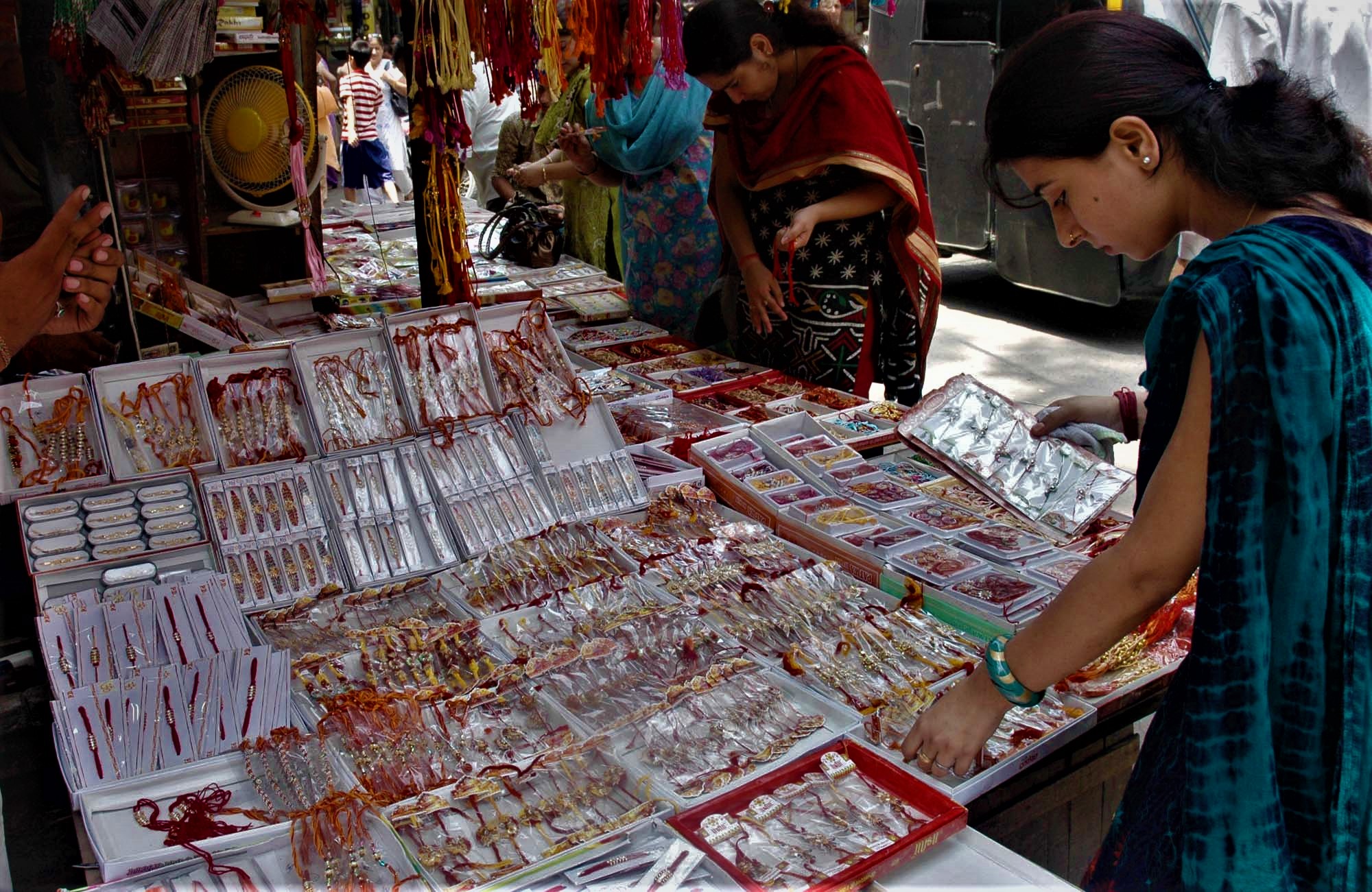
Around mid-August, Hindus all over the world celebrate Raksha bandhan. "Raksha" means protection, and "bandhan" means bound or binding.
In North India, the occasion is popularly called Rakhi, Raksha Bandhan or Rakshaa Bandhan- the tying of an amulet.
Raksha Bandhan is also called Rakhi Purnima or simply Rakhi or "Rakhri", in many parts of India. The same festival is celebrated as Janai Purnima in Nepal.

The festival is a Hindu festival and is also a secular festival which celebrates the love and duty between brothers and sisters. The festival is also popularly used to celebrate any brother-sister relationship between men and women who are relatives or biologically unrelated.

The festival is also observed by Jains as a religious festival, as on Raksha Bandhan, Jain priests give threads to devotees.

The festival is also celebrated by many communities as a secular festival. This secular aspect is observed among all people, irrespective of their religion, in West Bengal and Punjab. Various fairs are held in Punjab to mark the occasion.

On Raksha Bandhan, sisters tie a rakhi (sacred thread) on her brother's wrist. This symbolizes the sister's love and prayers for her brother's well-being, and the brother's lifelong vow to protect her. The festival falls on the full moon day (Shravan Poornima) of the Shravan month of the Hindu lunisolar Nepali calendar.

Raksha Bandhan is primarily observed in India, Mauritius and major parts of Nepal. It is also celebrated by Hindus in parts of Pakistan, and by some non-resident Indians and non-resident Nepalis around the world.


Raksha Bandhan as a religious festival focuses on performing the aarti and saying prayers prior to tying the rakhi. The prayers draw inspiration from the Hindu scriptures. The other religious feature is the application of the tilak on the forehead of the person wearing the rakhi.

The Meaning of Raksha Bandhan
Relationships are the essence of any festivity and it holds true for any Indian festival. Each occasion brings the family together which calls for a celebration. Raksha Bandhan is a celebration of one such relation - that of a brother and a sister. This relationship is no where so celebrated as in India. Raksha Bandhan is a festival which celebrates the bond of affection between brothers and sisters. It is a day when siblings pray for each others' well being and wish for each others' happiness and goodwill.
The name 'Raksha Bandhan' suggests 'a bond of protection'. On this auspicious day, brothers make a promise to their sisters to protect them from all harms and troubles and the sisters pray to God to protect their brother from all evil. The festival falls on the Shravan Purnima which comes generally in the month of August. Sisters tie the silk thread called Rakhi on their brother's wrist and pray for their well being and brothers promise to take care of their sisters.
                            

The Significance
Raksha Bandhan is now considered as a day to celebrate the sacred relation of a brother and a sister. Yet there have been examples in history where in rakhi has just been a raksha or protection. It could be tied by wife, a daughter or mother. The Rishis tied rakhi to the people who came seeking their blessings. The sages tied the sacred thread to themselves to safe guard them from the evil. It is by all means the 'Papa Todak, Punya Pradayak Parva' or the day that bestows boons and end all sins as it is mentioned in the scriptures.
Previously, Rakhi festival encompasses the warmth shared between the siblings but now it goes way beyond it. Some people tie Rakhi to neighbours and close friends signifying a peaceful co-existence of every individual. Rakhi Utsav was first popularized by Rabindranath Tagore to promote the feeling of unity and a commitment to all members of society to protect each other and encourage a harmonious Social life.
The scriptures, epics of Hinduism is peppered with stories of Rakhi and Raksha Bandhan. Some of these include:

Indra Dev

According to Hindu scripture Bhavishya Purana, in the war between Gods and demons, Indra - the deity of sky, rains and thunderbolts - was disgraced by the powerful demon King Bali. Indra’s wife Sachi consulted Vishnu, who gave her a bracelet made of cotton thread, calling it holy. Sachi tied the holy thread around Indra wrist, blessed with her prayers for his well being and success. Indra successfully defeated the evil and recovered Amaravati. This story inspired the protective power of holy thread. The story also suggests that the Raksha Bandhan thread in ancient India were amulets, used by women as prayers and to guard men going to war, and that these threads were not limited to sister-brother like relationships.

King Bali and Goddess Laxmi

According to this legend, credited to Hindu scriptures Bhagavata Purana and Vishnu Purana, after Vishnu won the three worlds from the demon King Bali, he was asked by Bali that Vishnu live in his palace, a request Vishnu granted. Vishnu's wife, Goddess Lakshmi did not like the palace or his new found friendship with Bali, and preferred that her husband and she return to Vaikuntha. So she went to Bali, tied a Rakhi and made him a brother. Bali asked her what gift she desired. Lakshmi asked that Vishnu be freed from the request that he live in Bali's palace. Bali consented, as well accepted her as his sister.

Santoshi Maa

Ganesh had two sons, Shubh and Labh. On Raksha Bandhan, Ganesh's sister visited and tied a Rakhi on Ganesh's wrist. The two boys become frustrated that they have no sister to celebrate Raksha Bandhan with. They ask their father Ganesh for a sister, but to no avail. Finally, saint Narada appears who persuades Ganesh that a daughter will enrich him as well as his sons. Ganesh agreed, and created a daughter named Santoshi Maa by divine flames that emerged from Ganesh's wives, Ruddhi (Amazing) and Siddhi(Perfection). Thereafter, Shubh Labh (literally "Holy Profit") had a sister named Santoshi Maa (literally "Goddess of Satisfaction"), who loved and protected each other.

Krishna and Draupadi

Krishna considered Draupadi his friend. When Krishna cut his finger while beheading Shishupal, Draupadi immediately tore off a piece of her sari and bandaged his cut. Krishna said that with this loving act, she wrapped him in debt and he would repay each “thread” when the time arrives. Indeed, whenever Draupadi needed Krishna’s protection she fervently prayed for his help, he came to the rescue and gave her unlimited cloth. This is one of the stories of the origin of the Raksha Bandhan festival.
In the epic Mahabharat, Draupadi tied a Rakhi to Krishna, while Kunti tied her Rakhi to her grandson Abhimanyu, before the great war.

Yama and the Yamuna

According to another legend, Yama, the god of Death had not visited his sister Yamuna for 12 years. Yamuna, the goddess of Yamuna river, was sad and consulted Ganga, the goddess of Ganga river. Ganga reminded Yama of his sister, upon which Yama visits her. Yamuna was overjoyed to see her brother, and prepared a bounty of food for Yama. The god Yama was delighted, and asked Yamuna what she wanted for gift. She wished that he, her brother should return and see her again soon. Yama was moved by his sister's love, agreed and to be able to see her again, made river Yamuna immortal. This legend is the basis for a Raksha Bandhan-like festival called Bhai Duj in some parts of India, which also celebrates brother-sister love, but near Diwali
Each colour has a significance in this festival. Tagore used white, so white signifies friendship. Indrani used red for her husband Indra, so red signifies Love and loyalty. The last Orange and Yellow is most popular in India used by Laxmi and Yamuna for their brothers Bali and Yama so this colour is used for brothers.
In today's scenario, the day has a different perspective. The occasion involves a pledge of life-time practice of moral, cultural and spiritual values. The values and the sentiments attached to the rituals of this festival are worth inculcating by the whole human race, the sentiments of harmony and peaceful coexistence. The festival of Raksha Bandhan assumes all forms of Raksha or protection, of righteousness and destroyer of all sin. The ritual of Rakhi tying has become so important that come what may, brothers and sisters try to visit each other place on this particular day tin order to bring back the oneness of the family, binding the family together in an emotional bond of love.
                   
Gifts and hugs
The brother gives his sister(s) gifts such as cards, clothes, money or something thoughtful. The brother may also feed his sister, with his hands, one or more bites of sweets, dry fruits and other seasonal delicacies. They hug, and the larger family ritually congratulate the festive celebration of brother-sister love and protection.
The brother(s) wear the Rakhi for the entire day, at school or work, as a reminder of their sister(s) and to mark the festival of Raksha Bandhan
Read More »